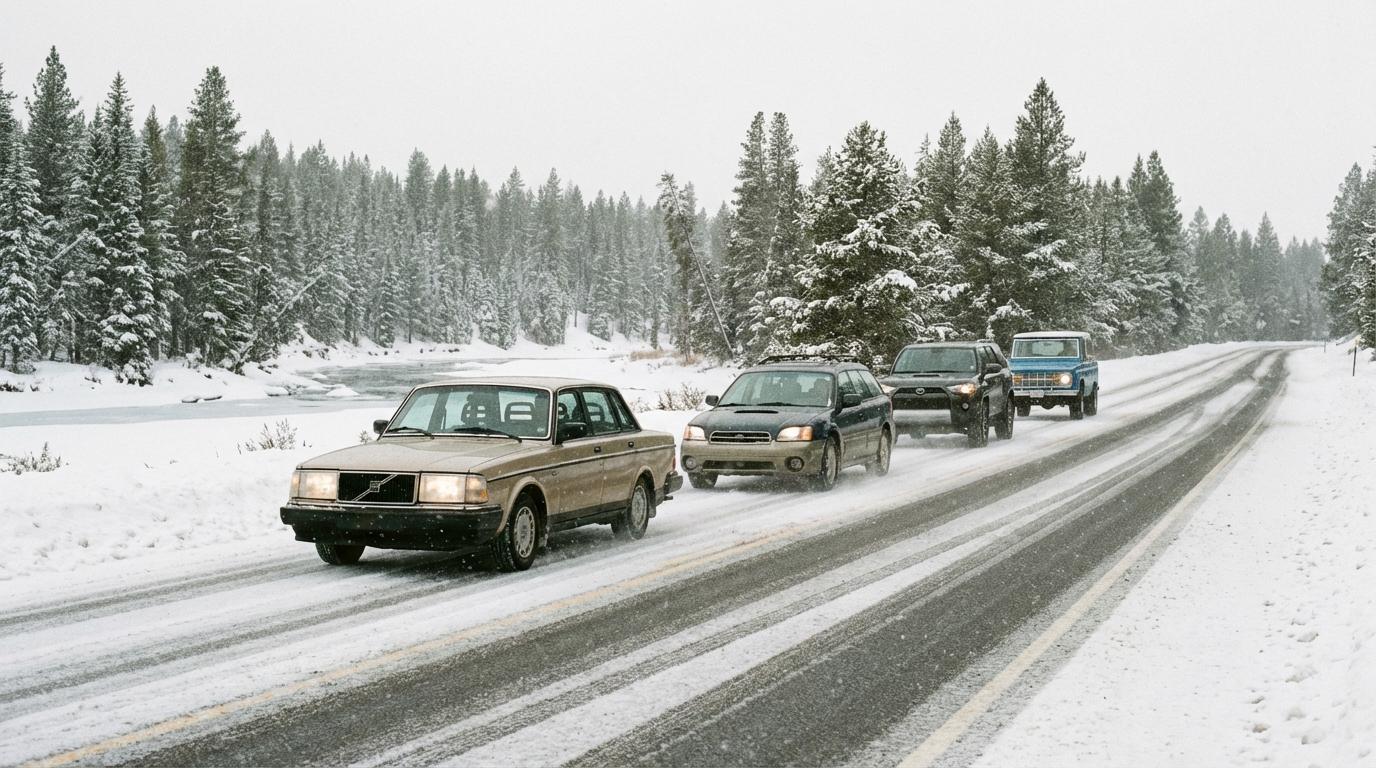
The first time I got convoy order wrong in winter, I did what most people do. I put the biggest vehicle up front. A friend’s Tahoe, full-size, four-wheel drive, looked like it could push through anything. Behind it, a Corolla on fresh winter tires. Behind that, two midsize sedans with whatever rubber they’d driven all summer on. I felt good about the lineup. The Tahoe would break trail, absorb whatever the storm threw at us, and the smaller cars would just follow in its wake.
We made it about twenty minutes before reality rewrote my plan.
Coming down a shallow hill toward a stop sign, the Tahoe locked its brakes and sailed right through the intersection. All that weight, all that confidence, those big all-season tires turning into four rubber hockey pucks on packed snow. The Corolla behind it? Stopped perfectly. Sat there in its lane like it had been parked, winter tires gripping through the slush without drama. I was in the third car and watched the whole thing unfold through my windshield wipers, knuckles white, brain rewriting everything I thought I knew about winter convoy order.
That moment changed how I plan every cold-weather drive with a group. I haven’t lined cars up by size since.
The Tire Walk
I have a habit now that my friends tease me about. Before we leave on any winter trip, I do what I call the tire walk. I crouch down next to every single car in the group and look at the tread. I run my fingers across it. I check if someone’s running winter tires, all-seasons, or something so bald it might as well be a drag slick. People laugh. They stand around with their coffee and make jokes. But that tire walk has saved us more than once, because it tells me something the drivers themselves often don’t know: which car can actually stop.
That matters more than anything else.
Stopping distance in snow is not about horsepower or drivetrain or how heavy your vehicle is. It is almost entirely about what rubber is touching the road. A lighter car on proper winter compound tires will outbrake a heavy SUV on all-seasons every single time on snow and ice. The physics are not ambiguous here. Winter tire rubber stays soft and pliable in freezing temperatures. All-season compound hardens. On ice, hard rubber barely grips.
So when I finish the tire walk, I already know the lineup. Winter tires go to the front. Not the biggest car. Not the newest car. The car with the best grip leads.
Why the Front Car Sets the Pace
If you lead a convoy in snow, your only job is to be boring. A friend told me that years ago and it stuck. “The best winter driver isn’t the bravest one,” she said, squeezing hand warmers in a gas station parking lot somewhere in Vermont. “It’s the most boring one.”
She was right. The lead car’s entire purpose is to set a pace that every car behind it can maintain without panic braking. That means driving well below the speed limit when the road surface demands it. That means not speeding up because a stretch of asphalt looks clear, only to discover the next curve is a sheet of black ice. That means swallowing your pride when someone in a lifted truck roars past you doing twice your speed, because your job is not to be fast. Your job is to be predictable.
Every fluctuation in the lead car’s speed gets amplified down the line. If the front car surges ahead by even a little and then brakes, the second car brakes slightly harder, the third car harder still. By the time that ripple reaches the back of the convoy, a gentle tap on the brakes up front has become a full emergency stop on a surface with almost no grip. It’s usually called the accordion effect, and on snow it’s how the last car ends up sideways.
Put your most patient, most consistent, most boringly reliable driver in front. Give them permission to go as slow as they need to. And then everyone else needs to actually respect that pace without tailgating or trying to push the group faster.
What about the rear?
The back position is where your best overall driver belongs. Not the most cautious one. The most skilled one.
Think about what happens when a convoy of several cars crosses a patch of ice. The front car hits it first, maybe doesn’t even notice. The second car hits it after the first set of tires has polished the surface slightly smoother. Each car after that gets a slicker version of the same patch. The last car in line is driving on what has effectively been buffed into a skating rink by every vehicle ahead of it. That driver needs reflexes, calm, and good tires. They also need to be the one watching for anyone in the group who starts drifting or struggling, because they can see the whole convoy from back there.
They’ll usually spot a car starting to slide before its driver is ready to admit it.
The Middle Is a Shelter
If someone in your group has bad tires, an underpowered car, or is just a nervous winter driver, they go in the middle. Protected on both sides by more capable vehicles. The front car sets a pace they can handle. The rear car watches their back. The middle is the safest, most forgiving position in the convoy, and there is no shame in putting yourself there if you know your car or your skills are not up to the conditions.
Nobody gets a medal for refusing the middle spot.
I have seen drivers turn it down because they felt it was somehow lesser. As if convoy position were a ranking of toughness. It’s just about putting each car where it causes the least trouble.
Count Seconds, Not Car Lengths
On dry pavement, most people follow too close. In snow, the consequences of that habit become catastrophic.
You need a gap of several seconds between each car in the convoy. Not a couple of car lengths. Seconds. Count them as the car ahead passes a sign or a tree. If you cannot count to at least five or six before you pass the same marker, you are too close. That gap will feel enormous. It will look like you are barely part of the same group. Other drivers will cut into the space. Let them. A random car wedging itself into your convoy is mildly annoying. A chain-reaction rear-end collision on ice is a trip-ending disaster that could put someone in a hospital.
If you are using a convoy intelligence app for your group, you can verify spacing by glancing at the map instead of closing the gap to keep visual contact. Trust the dots on the screen. Keep your eyes on the road ahead, not locked onto the taillights in front of you.
Not staring at those taillights is harder than it sounds.
When visibility drops in heavy snowfall, your brain wants to latch onto the red glow ahead of you and follow it like a beacon. The problem is that if that car drives off the road, you follow it. I have heard stories of three cars ending up in the same ditch because drivers two and three were tracking brake lights instead of reading the actual road surface. When the snow gets that heavy and you can barely see the car ahead, stop convoying. Seriously. Break formation. Each car drives independently. Use your tracking app to confirm everyone is still moving. Regroup at the next gas station or rest stop. Arriving a few minutes apart is infinitely better than arriving together in a guardrail.
Before the first flake falls
Talk through the plan while everyone is still standing in a warm parking lot. Agree on a few things: who leads, who anchors, what pace feels safe for the least confident driver, and what happens if someone needs to pull over. Agree on what you do if cell service drops in a mountain pass. If nobody has an answer before you leave, you’re just several cars heading the same way.
Decide in advance who has the authority to call a full stop. One person. Not a committee. When that person says pull over, everyone pulls over. No debates on the radio, no “it’s fine, keep going.” Snow conditions change by the mile, and the person closest to the worst conditions needs to be able to shut things down without arguing about it.
What I Tell People Now
Best tires lead. Best driver anchors the rear. Weakest car in the middle. Gaps measured in seconds, not car lengths. And do the tire walk, even if your friends make fun of you for it. Especially then.
Winter convoy driving is not about having the right vehicle. Half the people who end up in ditches during snowstorms are driving SUVs and trucks, because they trusted their drivetrain badge more than they respected the road. The groups I’ve seen get through clean picked their order by tires and by who stays calm, not by what’s biggest.
Done right, the whole drive is boring. You get there, you thaw out, and nobody has a story to tell.