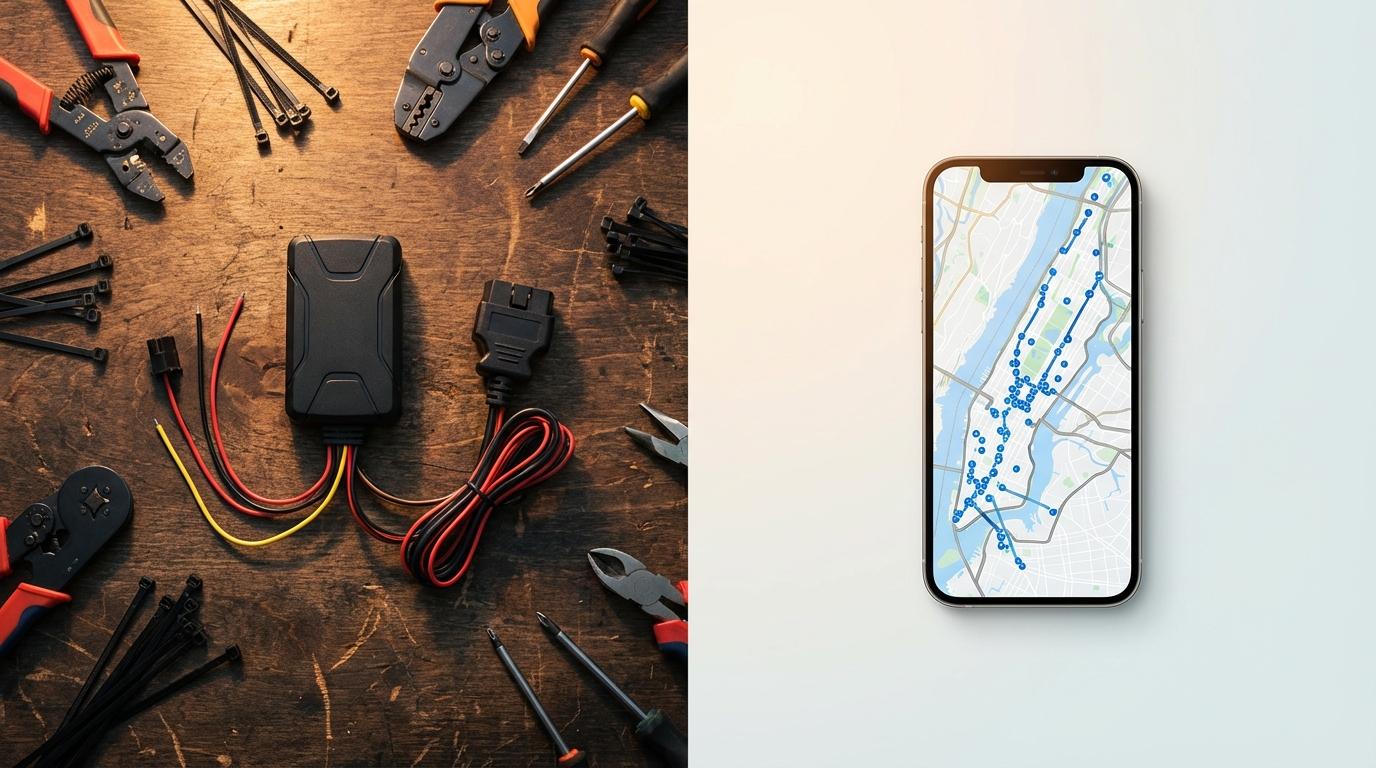
Qualcomm’s Snapdragon location engine, the chip doing the positioning in a lot of Android phones, listens to GPS, GLONASS, Galileo and BeiDou satellites at once, and on newer models it picks up a second frequency from some of them as well. Not that long ago a receiver like that was something you bought in a dedicated tracking box, which is why so many fleet owners still assume a phone can’t keep up.
I started looking into this last year when my cousin Anil called me from central New Jersey wanting a second opinion. He runs a six-truck landscaping business and had just been quoted for hardwired GPS units in every vehicle. His words were “Eight grand for six trucks, and I still have to pay monthly on top of that.” He wanted to know whether a phone-based setup would be good enough or whether he’d regret saving the money.
I spent a weekend reading spec sheets and forum threads where people had run the two side by side. Going in, I expected hardware to win on most of the technical points. It won on fewer than I thought, and the ones it did win turned out to matter a lot for some businesses and barely at all for Anil’s.
Accuracy mostly stopped being the argument
For years accuracy was the strongest case for a dedicated tracker, and it was a fair one. Early phone GPS receivers had cramped antennas, and quality swung wildly from one manufacturer to the next. Dual-frequency support, which used to show up mainly in survey gear and purpose-built trackers, started appearing in flagship phones several years ago and has since worked its way into mid-range models.
Under open sky, both a good tracker and a current phone usually land within about 3 to 5 meters of where they actually are. They receive the same satellite signals and run similar math on them (a tracker doesn’t get a private line to better satellites, which is something I’ve heard a sales rep imply).
Where the antenna starts to matter
Real job sites are rarely open sky, since tree cover weakens the signal and a phone lying in a cupholder under a metal roof has a poor view of the sky to begin with. Some hardwired installs put an external antenna on the roof of the cab, and that gives them a genuine edge when the surroundings are messy. The difference in those conditions is usually a position that wanders a few extra meters, though. If the question is which property a crew is parked at, or whether a truck took the right exit, both will answer it.
How often the dot moves
Phones tend to come out ahead here, because cheaper hardware trackers often report every minute or longer, and the units that report every few seconds cost more and use more cellular data.
A phone app can report every few seconds without trying very hard, because of how location works inside the phone. The GNSS chip is already computing fixes continuously for whatever needs them, the operating system collects those fixes and hands them out through a location service, and an app that asks for updates is subscribing to a stream the phone is producing anyway. Nothing in the app is switching the GPS on and off. A standalone tracker has to run its own receiver and push every fix out over its own modem, usually off a vehicle power tap with a battery as backup, so every extra report has a cost in power and data that the designers had to budget for. The phone already has a powered receiver and a data plan for other reasons, so the tracking app is mostly riding along on spending that was going to happen regardless.
Anil didn’t mention update speed on the phone with me, but it came up as soon as I asked how he handles customers. When one calls asking when the crew will show up, a dot from several minutes ago is close to useless.
The quote was mostly installation
A good chunk of Anil’s number was labor. Hardwired trackers have to be connected to the vehicle’s electrical system, which means running wire to a power source and hiding the unit somewhere a mechanic can reach later but a driver can’t easily get at. Plug-in OBD-II units are much simpler, but somebody still has to walk to every truck, plug one in and check that it’s reporting. For a six-truck lot that means a technician visit or a string of shop appointments.
A phone setup goes on the person instead of the truck. Each crew member installs an app, signs in, and that’s most of it.
Turnover is where this really adds up for landscaping, since Anil hires extra people every spring for cleanups and lets most of them go when the season slows down. With hardware, the tracker stays with the truck, which is fine until he needs to know which seasonal guy was driving it. On phones, a new hire is tracked from the first morning they open the app, and when they leave, their account goes with them. The cost math follows the same pattern, because hardware usually stacks a per-vehicle device lease, a cellular plan for each unit, the installation and then the software subscription, while a phone-based tool skips the first three. Trucks parked for the winter keep costing money with hardware. He didn’t love hearing that.
What hardware still does better
There are real cases where a phone is the wrong tool, and I don’t think I’d have spotted all of them without the forum threads, since people who’ve been burned are very specific about it.
| Hardwired tracker | Phone-based tracking | |
|---|---|---|
| Accuracy under open sky | A few meters | A few meters |
| Under trees or roofs | Better with a roof antenna | Drifts more, still usable |
| How often it reports | Depends on the plan you pay for | Every few seconds is normal |
| Works with nobody aboard | Yes | No |
| Hard for the driver to switch off | Yes | No |
| Engine data (fault codes, engine hours) | Often, through the OBD port | No |
| Setup | Per vehicle, with installation | Per person, an app install |
An OBD-II tracker can also read what the vehicle reports about itself, like fault codes and engine hours on many models, and some owners care about that more than location. A phone app gets none of it.
Nobody is carrying a phone
A trailer sitting in a yard overnight has no person attached to it, and phone-based tracking follows people. With its own power and modem, a hardwired tracker keeps reporting no matter who is around. That same logic is why moving companies weighing whether customers should track the truck end up thinking about the vehicle and not just the crew, since a load of someone’s furniture can sit in a parked truck while the movers are on a break.
Rough conditions and tampering
Purpose-built units are sealed against dust and rated for constant vibration. A phone in a landscaping truck handles New Jersey summers and winters fine, but I wouldn’t strap one to a concrete saw, and I don’t know exactly where the line sits for heavy equipment. Nobody I read had tested it carefully either.
Tampering is the bigger one, because a tracker wired in behind the dashboard is hard to disable without leaving signs, while a phone can be left at home or have location switched off. A phone that drives into a dead zone also stops sending live updates until it finds signal again, which I went into for trips without cell service, although at least that isn’t anyone’s choice. If the main thing you need is tracking the driver can’t get around, hardware has an advantage software can’t fully close.
What Anil did
He skipped the hardware, since his crews were already carrying phones all day and none of his equipment sits anywhere unattended long enough to worry him. His monthly bill came out at roughly a third of what the hardware would have cost him each month.
The one thing that went wrong in the first month was a new guy who never opened the app on his first morning, so the truck he was driving just wasn’t on the map until lunch, and Anil spent part of that morning calling around to find it.