After a few hours on the interstate, the music in my car stops being music. The playlist keeps going, the same shuffle of songs I’ve heard more times than I can count thumping out of the door speakers, but somewhere past the last coffee stop my brain quietly leaves the room. My eyes are still on the taillights of my friends’ cars ahead and my hands are still on the wheel, yet the songs have sunk into the same hum as the tires, something I’d only notice if it stopped.
I used to be a music person, and an annoying one about it. My road trip playlists were sorted by mood and tempo and by the exact stretch of highway they were supposed to play over, and I was sure audiobooks were for people who didn’t really like reading or for commuters who had given up on fun. Looking back, I was smug about this in a way that makes me wince.
Then my friend Priya plugged her phone into my car at a gas station outside Harrisonburg, while I was still screwing the fuel cap back on, and told me to give it a chapter before I judged it. It was Project Hail Mary by Andy Weir, narrated by Ray Porter, a name that meant nothing to me at the time. Porter doesn’t so much read that book as live inside the main character, and well before the next rest stop I had stopped thinking of it as a performance at all. It felt like a very good storyteller had climbed into the passenger seat, which, to be fair, Priya had, and she spent that whole stretch grinning at the windshield while I pretended not to care what happened next.
I haven’t gone back to playlists for long drives since.
What a Long Haul Does to a Playlist
A great song grabs you, peaks and lets go, which is perfect for a run and pretty useless in western Kansas, where the road has been straight for so long you start wondering whether the earth is round after all. When the playlist is familiar, your brain seems to load each song before it starts and gives it a little less attention every time it comes around. A new playlist has the opposite problem, because you end up half-judging every track and arguing with yourself about whether the last one was actually any good. Neither one keeps you switched on for long.
Stories work on you in a different way. A narrator sets up a kitchen on a space station or a motel parking lot in the rain, and your mind starts building it without being asked, filling in the smell of burnt coffee and the color of the carpet. You keep track of who lied to whom a few chapters back, you want to know what happens next, and that low, steady pull is enough to keep you out of the glassy-eyed highway trance while your eyes stay on the road.
The fall after Priya converted me, our group drove west into the West Virginia mountains, and about half of us had a book downloaded while the rest stuck with music. At the first gas stop past the state line, the music people climbed out grumbling about a truck that had crawled up every grade in front of them and a playlist that had started repeating itself. The book people were slower to get out of their cars, the way you are when you’re halfway through a scene and the engine is ticking as it cools. Then the road climbed into the Alleghenies, where the signal disappears for long stretches between ridges, and everyone streaming music lost it somewhere in the middle of a climb. Those of us with downloaded books didn’t realize anything had happened until we compared notes in Elkins, standing around in the cold with gas station coffee steaming out of paper cups.
The Behavioral Economics Mistake
I once put on a dense behavioral economics book for a long haul across Ohio, and by the next rest stop I had kept nothing and felt worse than if I’d driven in silence. The wrong book is almost worse than no book, because once you lose the thread you spend the afternoon annoyed with yourself for not paying attention to something you chose.
Anything built on charts and figures is wasted behind the wheel, and prose so literary that you need to hear a sentence again belongs in a hammock on a slow afternoon.
What you want is a story that pulls you along. A Lee Child thriller keeps a pace that suits a highway, and a memoir read by its own author can feel like someone talking to you from the passenger seat. Matthew McConaughey reading Greenlights is the one I push on people most, partly because he sounds like he’s having more fun than anyone should be allowed to have in a recording booth. On a long scenic run, the kind of trip like driving Route 66 with four generations in the car where the landscape is half the point, travel writing layers on nicely. Listening to Bill Bryson’s A Walk in the Woods while you’re driving through actual woods gives you a strange doubled feeling, as if the book and the windshield were showing the same film.
The narrator matters more than the book. A flat, even reading will put you under faster than a straight road at dusk, so play the sample before you buy, and if the voice never speeds up or slows down and every character sounds like the same tired accountant, keep looking.
“Did You Get to the Part Where…”
The side effect nobody in our group saw coming was that rest stops got better.
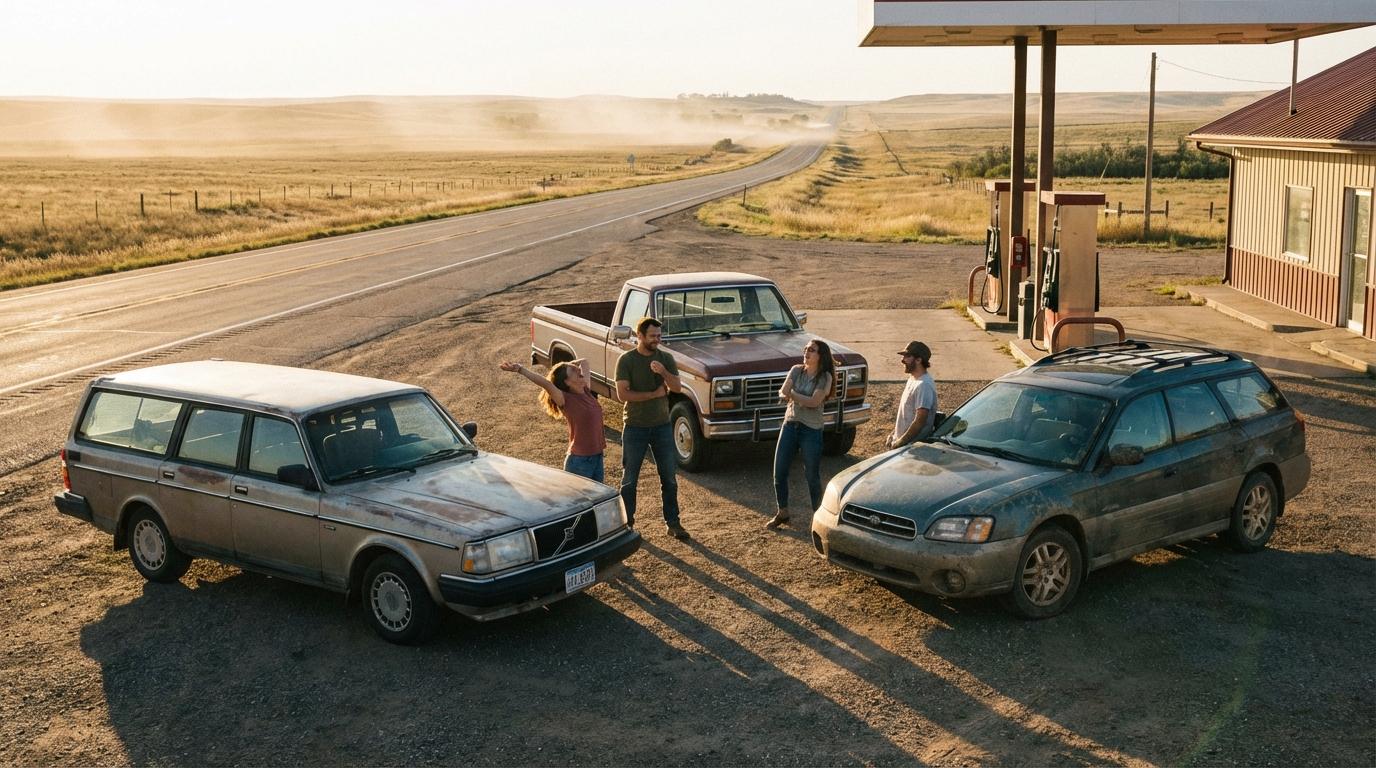
On music trips a rest stop is a chore where everyone stretches and stares at their phone, and there isn’t much to say because you’ve all been looking at the same road for hours. People on book trips get out mid-chapter, still squinting in the sunlight, and the first thing out of their mouths is “You won’t believe what just happened.” The patch of asphalt by the pumps turns into a swap meet for story fragments, with somebody stuck in wartime England and somebody else on a spaceship who will not stop talking about it, all over the diesel smell and the rattle of the ice machine.
We started trading picks before each trip, right alongside working out what to do when a red light splits the convoy and arguing about where to eat lunch. When a few people grab the same book, a second rhythm shows up at every stop, with “What chapter are you on?” quietly replacing “How far back are you?”, and the group chat after a trip ends up sounding like a book club that happens to own cars.
The Part That Actually Matters
The entertainment is nice, but the reason I keep pushing books on everyone in our convoys is tiredness. Drowsy driving is one of the quieter ways a road trip goes wrong, and long convoy drives carry an extra pressure of their own, because nobody wants to be the person who slows the group down. When the lead car is still rolling and your dot is right there on everyone’s map, pulling over can feel like letting people down, even though nobody in our group would ever say that out loud.
Music has never fixed that for me, no matter what I put on. Familiar songs are the worst, since I can sing along to them perfectly well while half asleep, and turning the volume up only buys a few minutes before the heaviness creeps back into my eyelids. A book I care about keeps me present in a calmer way, because I’m busy building scenes and following who said what, and there’s no room left for that slow slide toward sleep. It also tells on me when I’m fading, because if I keep losing the thread of a story I actually want to hear, I take that as the sign I’m too tired to be driving, and a playlist has never once given me that warning.
None of this replaces sleep, and if you’re exhausted, pull over and hand the keys to someone else or find a motel. For the gray stretch between fine and fading, though, a good story has done more for me than any chorus ever has.
Before You Leave the Driveway
When you’re planning a multi-car trip, put an audiobook on everyone’s prep list next to the route and the snacks. Libby works through your local library if you have a card, and Libro.fm sends money to independent bookstores if you’d rather buy. Download it instead of streaming it, because rural dead zones swallow your signal without warning, and on a trip with several cars the gaps already cause enough trouble when your navigation app has no idea where the other cars are. Get the book playing before you pull out, so you never have to touch your phone once you’re moving.
On the drive home from West Virginia, Priya’s car and mine ended up trailing the group, and it turned out we were near the end of the same book without either of us knowing. At the last gas stop before Harrisonburg she stayed in her car with the windows fogging up until her chapter finished, and I was doing exactly the same thing a few pumps over, which we only figured out when we both climbed out at the same moment. She pointed at me across the pumps and said, “Don’t, I’m not ready to talk about it.” The others were long gone by then, their dots creeping toward home on the map on her phone, and we stood there in the dark smelling of gasoline and arguing about the ending until a text came in from somewhere up the road asking whether we’d broken down.