You need dedicated hardware bolted to every vehicle if you want real fleet tracking. That was true a decade ago, and it stopped being true a while back.
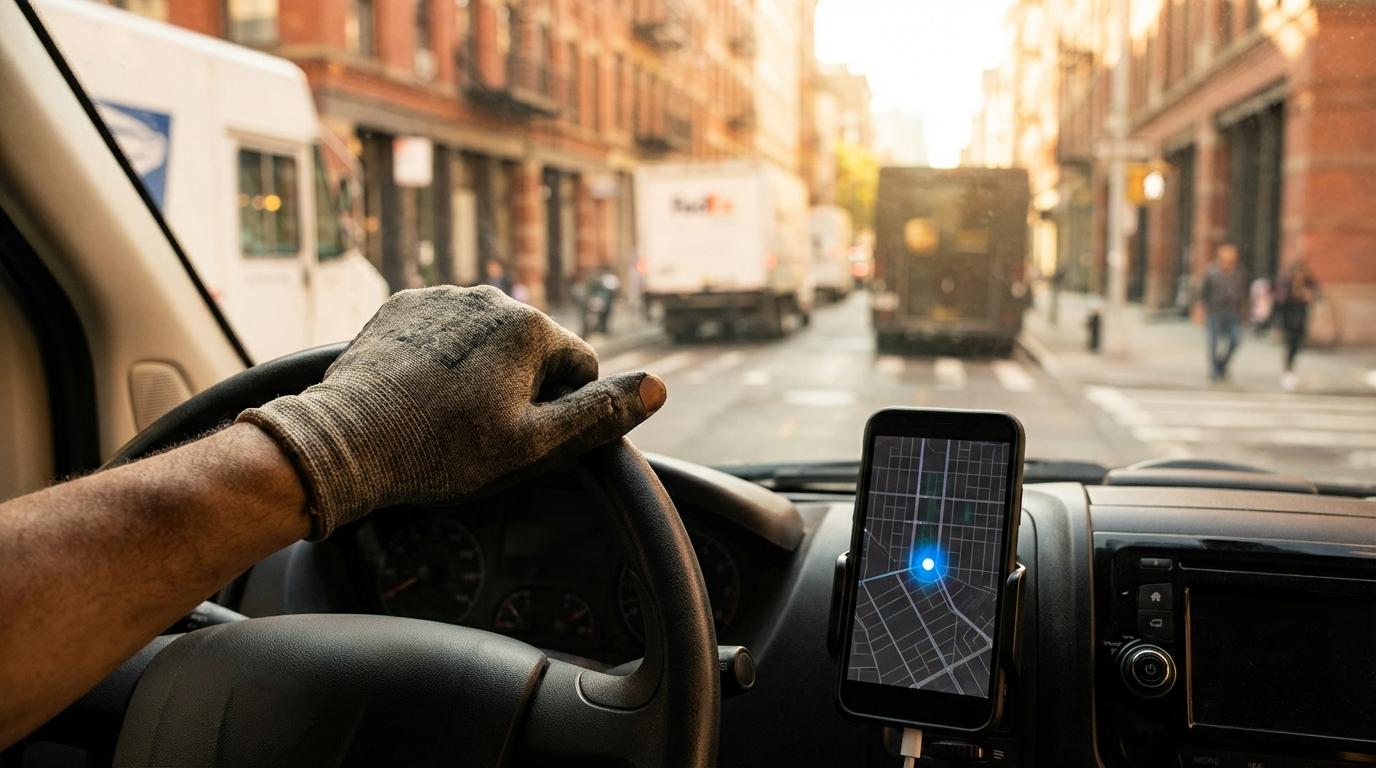
My first week as a delivery driver was in 2016. The company sent a technician to install a Garmin fleet tracker on my van’s dashboard, and it took him most of a morning. I sat in the break room eating vending machine pretzels while he ran wires and mounted brackets. Once it was in, the thing updated roughly every 45 seconds and froze whenever the temperature dropped. Its screen looked like it came off a calculator. My phone, sitting in the cup holder, had Google Maps pulling live traffic and recalculating routes in a couple of seconds.
That contradiction stuck with me.
It bothers me more now that I manage drivers myself and keep watching companies buy hardware when every driver already carries a GPS receiver in their pocket. The phone is already paid for and already charged, and it usually does the job better than whatever gets screwed to the dash.
Accuracy stopped being the argument
The pushback I hear most from other ops managers is accuracy. They assume a dedicated tracker is more precise than a phone, which was a reasonable assumption when I started driving.
Newer smartphones carry dual-frequency GNSS chips, and testing written up in Inside GNSS found dual-frequency phone positioning kept errors within about three meters. For deciding whether a driver is at the customer’s address or still on the highway, that is plenty. When those chips first reached consumer phones, Gian Gherardo Calini of the EU Agency for the Space Programme said they would “open up applications that previously only ran in dedicated devices intended for professional use.” He was talking about developers in general, but fleet tracking fits that description. Nobody managing a delivery team needs sub-meter precision. You need to know which stop the driver is at, and a phone tells you that without anyone drilling holes in a dashboard.
I was slow to trust phone tracking myself. Some of that was habit. In my head, “real” fleet tracking meant a box wired into the vehicle, and anything that wasn’t physically attached felt like a toy. I spent budget defending that instinct for longer than I’d like to admit.
Where phones pull ahead is update speed
Cheap tracking dongles often report once every sixty seconds, and some economy plug-in units that advertise “real-time” tracking poll even less often once the cell signal gets weak. A phone app built for live location can send a position every two or three seconds while the driver is moving.
Consider what a sixty-second gap means in a city. A driver working through blocks at normal urban speed can cover close to half a mile between pings. If a customer calls asking where their delivery is, that kind of uncertainty makes you sound like you have no idea, because you don’t. With updates every few seconds, the guess shrinks to roughly the length of a driveway.
Last year I ran both setups side by side for a while. On one stop the hardware tracker showed a driver sitting a block and a bit short of the address, because its last ping landed before his final turn. The phone showed him pulling into the right driveway. A customer happened to call right then, and I could tell her he was outside. Going off the box, I’d have said “a few minutes” while he was already knocking.
Installing it costs more than the box
A basic OBD-II tracker can run up to $200 per unit, hardwired units cost more, and then there’s the monthly service fee per vehicle on top. Plug-in devices go in fast, but they occupy the diagnostic port and anyone can pull them out. Hardwired installs take hours per vehicle, and the van sits off the road the whole time. Book a whole fleet through an installer and you’re running short on vans for days. With a phone app, the driver installs it and signs in, and a few minutes later they’re on the map. The vehicle never leaves the road.
When I moved a dozen vans off hardware trackers, I did it over a lunch break. There was no technician and nobody waiting in a parking lot. Drivers installed the app before their afternoon routes, and every one of them was on my map before the hour was up.
The objections I hear
“What if the driver leaves the phone at home?” In all my years managing drivers this has happened a couple of times. People don’t forget their phones the way they forget a lunch bag, because the phone runs their navigation. When it did happen, I noticed quickly because the driver’s dot never started moving. A tracker on a parked van would have shown me the same thing.
“Won’t it kill the battery?” Running GPS all day does use power, and a few years ago that was a real problem. Every van I’ve managed has a charging port, so we keep a cable in each one and the question goes away.
“Drivers will just switch location off.” Some might try. When a phone stops reporting, the driver’s dot stops updating, which is about as visible as a dongle that suddenly goes quiet. Fixing it is cheaper, though. A pulled dongle means buying and installing a new one, and switched-off location gets sorted with a conversation.
“We need engine data.” Fair enough. If your operation actually uses fault codes or fuel consumption figures, a phone can’t give you those. I’ve talked to plenty of fleet managers who pay for diagnostics and have never opened the engine health screen once, though. They wanted to know where their people were, and they ended up paying for a bundle of extras on top.
The contract problem
If you spent serious money on hardware last year and signed a multi-year service contract, you probably don’t want to hear that the phones in your drivers’ pockets could have done the tracking. I get it, because I signed one of those contracts. The sales demo was full of heat maps and geofences, and I bought the whole package. When it came up for renewal I let it lapse, and the tracking I actually used got better.
My mornings look different now. Drivers start the day signed in on their phones, and I see everyone on one map that keeps moving. If someone is behind, I can usually tell from where they are before they call me. When a customer asks about a delivery window, I answer from where the driver is right now.
Reassigning work is quicker too. When a driver called in sick a few weeks ago, I could see who was closest to his stops and moved them around. The new address went into the same phone that was sharing their location, and they navigated from there. A hardware tracker doesn’t give directions, so your drivers are using their phones for navigation anyway, and you end up paying for two devices to cover one job.
Earlier this year one of my drivers got a flat on a rural route and called to say she was “somewhere on the county road past the feed store.” I pulled up her location on my screen and saw exactly which stretch she was on. Roadside assistance got her coordinates from me and found her without driving up and down looking.
Where hardware still makes sense
I’m not saying hardware trackers are useless.
Heavy equipment that sits on a site with no operator, or a fleet that genuinely runs on engine diagnostics, has good reasons to bolt something in. If you run people on delivery or service routes, though, and the main thing you need is where they are right now, the device that does it is already in their pocket.
I still think about that morning in the break room, eating pretzels while a technician wired a GPS into my van that was slower than the phone in my pocket. The company paid him for half a day so they could find out where I was once every 45 seconds. My phone could have told them more often, and nobody asked it.